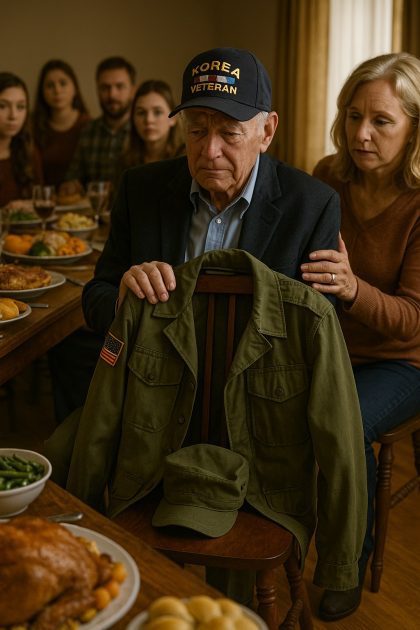
Every Thanksgiving, the Johnson family gathered around the same long wooden table. The smell of turkey and pies filled the air, the clatter of dishes echoed through the kitchen, and laughter spilled from every corner of the house. But at the head of the table sat an empty chair — a tradition that had started years earlier when their grandfather, Henry, passed away.
Henry had been a Korean War veteran. He was quiet, steady, and the kind of man who always put others first. When he died, the family decided to honor him each year by leaving his chair empty, draped with his old army jacket and cap. It was their way of saying he was still with them.
This year was no different — at least not at first. The family arrived one by one, setting down casseroles, greeting each other with hugs, and sneaking tastes from the kitchen. The chair stood at the head of the table, jacket neatly folded, cap resting on the seat. Children asked about it as they always did, and parents reminded them, “That’s Grandpa’s chair.”
Dinner began. Stories were told, blessings were shared, and glasses clinked in gratitude. Then, just as plates were being passed around, there was a knock at the door. Everyone paused, confused. They weren’t expecting anyone.
Emily, the youngest daughter, went to answer it. On the porch stood an elderly man holding a weathered box. His face was kind but lined with years, and his eyes carried something heavy yet gentle. “I’m sorry to intrude,” he said softly. “My name is Walter. I served with Henry overseas.”
The room fell silent as Emily ushered him inside. The family exchanged stunned glances. Most of them had never met one of Henry’s old comrades. Walter walked slowly to the table, setting the box down in front of the empty chair.
“I heard about his passing years ago,” he began, his voice trembling, “but it took me a long time to find the strength to visit. Henry saved my life more than once. I owed it to him — and to all of you — to share what he meant to me.”
He opened the box. Inside were black-and-white photographs, letters, and a few medals Henry had never spoken of. The family gasped. They had known he served, but he had rarely talked about his experiences.
Walter pulled out a photo of two young men in uniform, arms slung around each other, grinning despite the mud on their boots. “This was your grandfather,” Walter said, his hand shaking. “He carried all of us through the darkest days. And he never once asked for recognition. He just wanted to come home.”
Tears streamed down faces around the table. Henry’s children and grandchildren leaned closer, listening as Walter shared stories — of nights in freezing trenches, of Henry’s humor that kept spirits alive, of the moment he risked his life to pull Walter to safety after an ambush.
For the first time, the family understood the weight of the empty chair. It wasn’t just a symbol of their grandfather’s absence. It was a reminder of his sacrifice, of the man he truly was when the world demanded the most from him.
When Walter finished, he looked at the chair draped with Henry’s jacket. “He saved me,” he whispered, voice breaking. “And because of him, I got to live a full life. I have children, grandchildren, all because of Henry. So when you leave this chair empty, know it’s not just for you. It’s for men like me too.”
The family bowed their heads in silence. Then, Henry’s daughter stood and placed Walter’s hand on the chair. “Tonight,” she said softly, “you sit here in his place.”
Walter resisted at first, shaking his head, but they insisted. With tears streaming down his face, he lowered himself into the seat. For the first time in years, the empty chair was filled — not by Henry himself, but by the living legacy of the man he had saved.
That Thanksgiving meal was unlike any other. The food tasted richer, the prayers carried deeper meaning, and the laughter was tinged with gratitude. The family realized that Henry’s spirit lived not only in their memories, but also in the countless lives touched by his quiet heroism.
From then on, the chair remained at the head of the table each year. But now, alongside the jacket and cap, sat the box of photographs and medals. It was no longer just an empty chair. It was a story, a bond, and a reminder that true sacrifice leaves ripples far beyond what the eye can see.