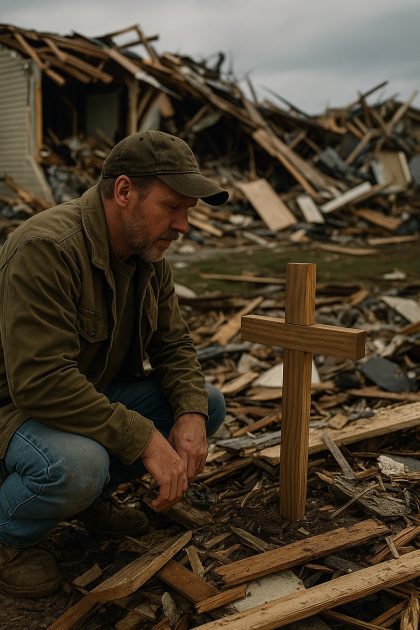
The storm came without mercy. Winds roared like a freight train, ripping roofs from houses and uprooting trees. The night sky flashed with jagged lightning as families huddled together in the dark, praying that their homes would hold. When morning finally came, the small town looked unrecognizable. Whole streets were gone, reduced to piles of debris.
Among the families who lost everything was the Harris family. Their father, James, a veteran who had built his home with his own hands, stood in disbelief as he looked at what remained. Walls were flattened, furniture scattered across fields, and memories buried under the weight of broken lumber and twisted metal. His wife clutched his arm, whispering, “At least we’re alive.” Their children, wide-eyed and silent, held onto each other.
Neighbors poured out to help one another, carrying buckets, lending tools, and offering shoulders to cry on. The air was filled with the sound of chainsaws, the cries of those who had lost, and the quiet determination of those beginning to clean up.
As James sifted through the rubble, his hands raw and his back aching, he pulled aside a broken beam. Beneath it, something caught his eye. A small wooden cross, no taller than his arm, stood upright in the middle of the wreckage. It wasn’t broken, wasn’t even scratched. It had been a decoration on their mantle, carved years ago by his grandfather. Somehow, through the chaos of the storm, it had remained standing.
James froze. His wife saw it too and gasped, covering her mouth with trembling hands. Neighbors gathered, their work slowing as word spread. People began walking over, staring at the cross that seemed untouched in the middle of devastation.
For a long moment, no one spoke. It was as if the world itself had paused to acknowledge the quiet miracle. James knelt beside it, his knees pressing into the wet ground. Tears filled his eyes as he whispered, “We lost the house, but not our faith.”
His children joined him, kneeling by his side, their small hands touching the wooden surface. The pastor from their church arrived later that day, called by a neighbor who had seen the scene. Standing over the cross, he lifted his voice and prayed for the family, for the town, and for everyone who had lost. People bowed their heads, some weeping openly, as the words rose above the sound of chainsaws and sirens.
In the days that followed, the cross became more than just a piece of wood. People from all over town came to see it. Some left flowers, others knelt in prayer. Volunteers rebuilding homes said it gave them hope, a sign that no matter how strong the storm, there were things that could not be destroyed.
James and his family eventually rebuilt their house on the same land. The cross, however, was no longer just a decoration. They placed it in the yard, anchored deep in the soil, where it could be seen from the road. It became a landmark for the town, a reminder of survival and of the strength found in faith.
Years later, when people spoke about the tornado, they always mentioned the Harris home. They spoke of how the storm had taken so much, but how it had left behind a symbol. The cross stood not only for the Harris family but for everyone who had endured that night.
James never forgot the moment he saw it standing there. In his heart, it wasn’t just coincidence. For him, it was God’s way of saying, “I am still here.”
And whenever the winds howled again in the distance, he would look out the window at the cross in his yard, standing tall against the sky, and feel peace settle in his chest.