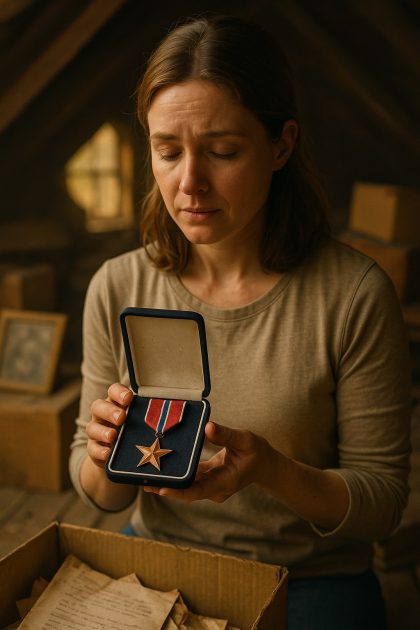
The attic smelled of dust and age. Boxes stacked high touched the slanted roof beams, each one holding pieces of a life lived long ago. Emily and her brother had been sorting through their late grandfather’s house all week, carefully deciding what to keep, what to donate, and what to let go.
They expected to find old photo albums, broken toys from childhood, maybe even a few forgotten treasures. But no one expected what they discovered that afternoon.
It happened when Emily opened a small wooden trunk tucked behind the rest. The lock had rusted, the hinges squeaked, and inside lay a few folded uniforms, yellowed letters, and at the very bottom, a small velvet box. She picked it up, brushing away the dust, and opened it slowly.
Inside was a medal. Its ribbon was faded, but the shine of the bronze star still caught the light from the attic window. She stared at it, speechless. “Mom,” she called softly, her voice breaking.
Her mother climbed the stairs and gasped when she saw it. “I didn’t know he still had this,” she whispered.
Emily turned the medal over in her hands. “Did Grandpa ever talk about this?” she asked.
Her mother shook her head. “He never told us much about the war. He just said it was something he wanted to leave behind.”
The letters inside the trunk revealed more. They were written in careful script, some addressed to his parents, others to his young bride. One letter in particular stood out. It described a night when his unit was under heavy fire. He had dragged two injured soldiers to safety, ignoring his own wounds, and continued fighting until they were out of danger. That act of courage had earned him the medal.
Emily’s eyes filled with tears as she read the words. She could almost picture him, younger, braver, standing in the middle of chaos and still thinking of others first. It was a side of her grandfather she had never known. To her, he had always just been the gentle man who fixed her bike and whistled while working in the garden.
The family gathered that evening in the living room, the medal and letters laid carefully on the coffee table. No one spoke for a long time. Finally, Emily’s mother said, “He never wanted praise. He just wanted a quiet life after it all. But we should honor this.”
The decision was made to display the medal in a shadow box along with the letters. They planned a small memorial at the local veterans’ hall. The thought of sharing his story brought them comfort.
When the day arrived, the hall was filled with people who had known her grandfather as a neighbor, a friend, a church member. Few knew about his heroism. As Emily’s brother read aloud the letter that described the night of bravery, people wiped their eyes. Veterans in the crowd stood straighter, saluting the memory of one of their own.
For Emily, it was overwhelming. She realized her grandfather’s silence hadn’t been because he was ashamed, but because true heroes don’t seek applause. He carried his burden privately, living with memories too heavy to speak of, while giving his family the gift of a peaceful, loving home.
After the service, Emily placed the medal back into the box and held it close. She felt pride swell inside her chest. It wasn’t just a piece of metal. It was a symbol of who he really was, the depth of his courage, and the sacrifice he chose never to boast about.
That night, she sat on the porch, staring at the stars. She thought of him somewhere above, finally at peace, maybe even smiling at the thought of his secret finally being told. She whispered into the night, “Thank you, Grandpa. We know now.”
The medal was no longer forgotten. It had become a story to pass down, a reminder that sometimes the quietest people carry the greatest legacies.