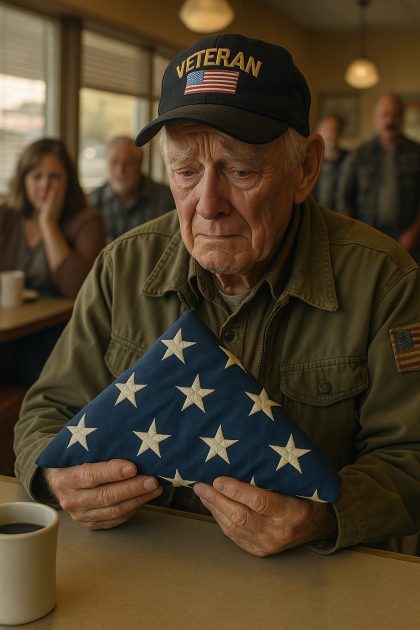
The diner smelled of coffee and bacon, the kind of place where time seemed to stand still. Locals filled the booths, laughing and chatting as the jukebox hummed softly in the corner. It was the kind of ordinary morning that no one expected to remember—until he walked in.
An elderly man shuffled through the door, his steps slow but steady. He wore a faded jacket with patches sewn onto the sleeves, the kind that told its own story without words. People greeted him politely, but he seemed lost in thought. Instead of sliding into a booth, he chose the counter seat near the window.
When the waitress asked for his order, he only requested coffee. His hands trembled slightly as he reached into a worn leather bag that sat at his side. Slowly, he pulled out something wrapped carefully in cloth. He laid it gently on the counter and began to unfold it.
At first, no one paid much attention. But as the cloth came away, the unmistakable sight of a folded American flag appeared. The diner grew quiet. Forks paused midair, conversations stilled, and all eyes turned toward him.
The man placed the flag on the counter with reverence. He looked down at it, his lips moving as if whispering a prayer. A few moments later, he spoke just loudly enough for the people nearby to hear.
“This flag was handed to me the day I buried my best friend. He saved my life overseas. I promised I’d honor him every year on this date… and today marks fifty years since that day.”
Silence hung in the air. A mother at a nearby booth pulled her child closer. Two construction workers set down their mugs, their faces suddenly solemn. The waitress wiped her eyes with the edge of her apron. It was as if the weight of his words fell over the entire room.
The man continued, his voice cracking. “He never made it home. I did. I still ask myself why.”
A younger veteran sitting in the back rose from his table. He walked forward and placed his own cap beside the folded flag. Then another man stood, a gray-haired fellow in a flannel shirt, and he laid down his hand on the old veteran’s shoulder. One by one, people across the diner began to gather around. No one planned it, but it became a circle of respect and remembrance.
Tears welled in eyes both young and old. Some prayed silently. Others simply bowed their heads. The flag sat there between coffee cups and salt shakers, a reminder of sacrifice and the cost of freedom.
The old man finally looked up, surprised at the crowd that had formed. His eyes shone with gratitude. “Thank you,” he whispered. “I didn’t mean to make a scene. I just needed to keep my promise.”
One woman stepped forward and said softly, “You didn’t make a scene. You reminded us.”
The entire diner applauded, not with loud cheers but with the kind of slow, heartfelt clapping that comes from deep respect. The sound echoed through the small restaurant like a hymn.
The waitress refused to let him pay for his coffee. The construction workers insisted on covering his meal. The younger veteran promised to return next year to stand beside him. Strangers left the diner feeling connected in a way they hadn’t expected when the morning began.
The flag was folded again, handled with the same care as if it were a living thing. The man tucked it back into his bag, his shoulders a little straighter now. He left the diner with quiet dignity, but the memory of that morning would stay with everyone who witnessed it.
For the rest of the day, people in town spoke about the moment. In a world where so much divides, that diner became a place where everyone shared the same truth—honor, sacrifice, and love for a friend who gave everything.
And it all began with one man, a folded flag, and a promise kept.