In a quiet town where everyone knew each other’s names, Mr. Harold Thompson was simply known as the man with the limp. He ran the hardware store on Main Street, always with a smile, always willing to lend a hand. Children grew up seeing him shuffle across the sidewalk, never asking questions.
What most didn’t know was that Harold had been living with pain every single day since returning from war decades earlier. He never talked about it. When customers asked about his leg, he brushed it off with a joke or a change of subject. To him, life wasn’t about dwelling on the past.
One summer morning, the town gathered for the annual Independence Day parade. Flags lined the streets, children waved sparklers, and the high school marching band played with proud energy. The veterans’ group, as always, walked near the front.
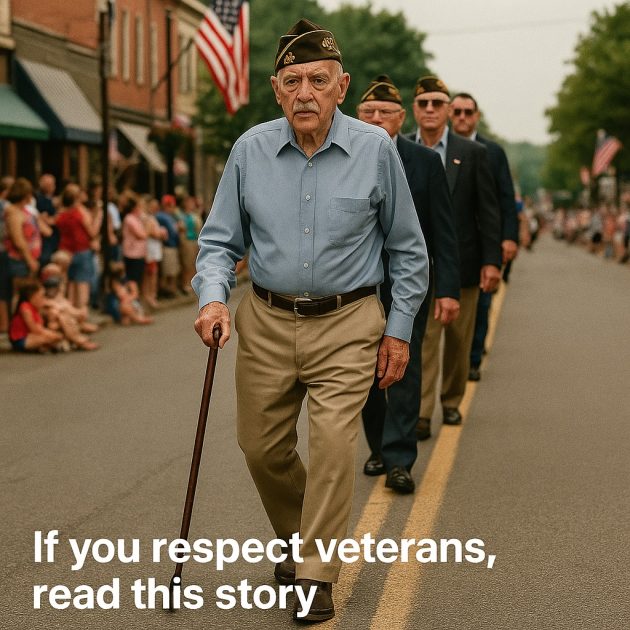
Usually Harold stayed at the sidelines, cheering them on. But this year, for reasons no one knew, he decided to join the march. Wearing a pressed shirt and his old cap with faded insignia, he stepped onto the street with the other veterans.
At first the crowd clapped politely. Then, as Harold’s limp grew more noticeable with each step, silence swept over the street. Mothers whispered to their children, explaining that Harold had been wounded while serving overseas. Some said he had taken shrapnel to the leg while pulling a fellow soldier to safety. Others recalled stories of nights in a field hospital when doctors weren’t sure he would walk again.
For the first time, Harold did not hide his limp. He walked slowly, steadily, his face calm but determined. The sun glinted off his cap, and his eyes looked straight ahead. With every step, people saw not weakness but strength — the kind of strength born from sacrifice.
By the time the veterans reached the center of town, the crowd had grown emotional. Applause erupted, louder than any cheer of the day. People rose to their feet. The band faltered, unable to drown out the sound of hundreds of voices shouting their gratitude.
Harold’s grandchildren, sitting on the curb, stared in awe. They had always seen him as a kind grandfather who told stories at bedtime. Now they saw him as something greater — a man who had once risked everything for the country he loved.
Later that afternoon, neighbors stopped by his house with baked pies and handshakes. One man, with tears in his eyes, said, “I never knew what you went through. Thank you.”
Harold shrugged humbly, almost embarrassed by the attention. “I just did what anyone would have done,” he replied. But deep down, he knew the truth: not everyone could have endured what he endured.
For the town, that parade became a turning point. People began to see veterans differently, realizing that behind every quiet face was a story untold. Harold’s limp was no longer just a limp. It was a badge of courage, a reminder of sacrifice, and a lesson in resilience.
As the years passed, the story of that parade was retold again and again. Parents told their children about the man who walked despite the pain. Teachers mentioned Harold during history lessons, explaining that heroes don’t always live in books — sometimes they run the hardware store across the street.
Harold himself never sought recognition. He went back to his daily routine, opening his shop at sunrise and greeting each customer with the same cheerful grin. But he carried himself a little differently after that parade. The silence he had kept for so long was replaced by the unspoken understanding of his community.
And whenever the parade rolled through town again, children would look for him — the man with the limp, who showed them what true courage looked like.